Microscope root canal treatment in Lutsk: benefits and questions
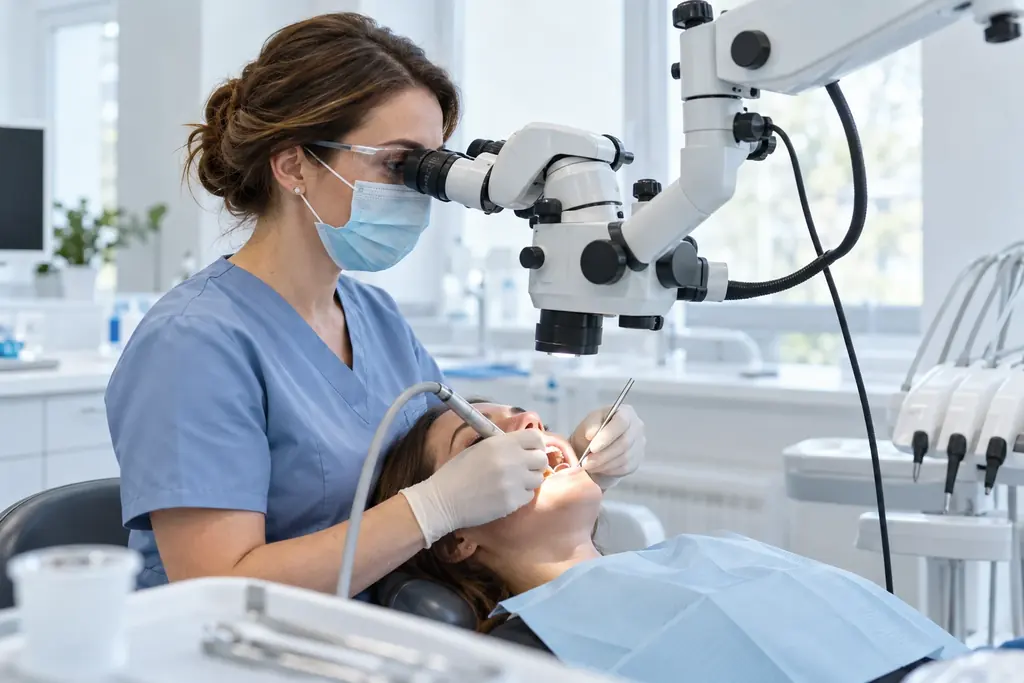
A dental operating microscope gives the dentist magnification and bright, focused light, which helps to see small canal entrances, cracks and fine details inside a tooth. It is used mainly in endodontics, including root canal treatment and retreatment. The microscope is a tool: it does not guarantee a result, and not every clinic or clinician has one. In Lutsk, ask Dentika or Filigranno to confirm microscope availability and a suitable clinician before you book, and ask for the estimate for the whole procedure.
When should I see a dentist urgently?
- Strong pain that starts spontaneously or wakes you at night
- Swelling of the gum, cheek or face
- Fever together with a painful tooth
- Difficulty swallowing or breathing — call emergency medical services
What magnification helps a clinician see
Root canals are narrow, curved and sometimes hidden. Magnification and coaxial light let the dentist look into the tooth much more closely than with the naked eye, which can help to find additional canals, to see cracks and to check the cleanliness of the canal walls.
Being able to see more is not the same as getting a better outcome automatically. The result still depends on the diagnosis, the tooth, the dentist’s skill and the restoration afterwards.
When microscope use may be discussed
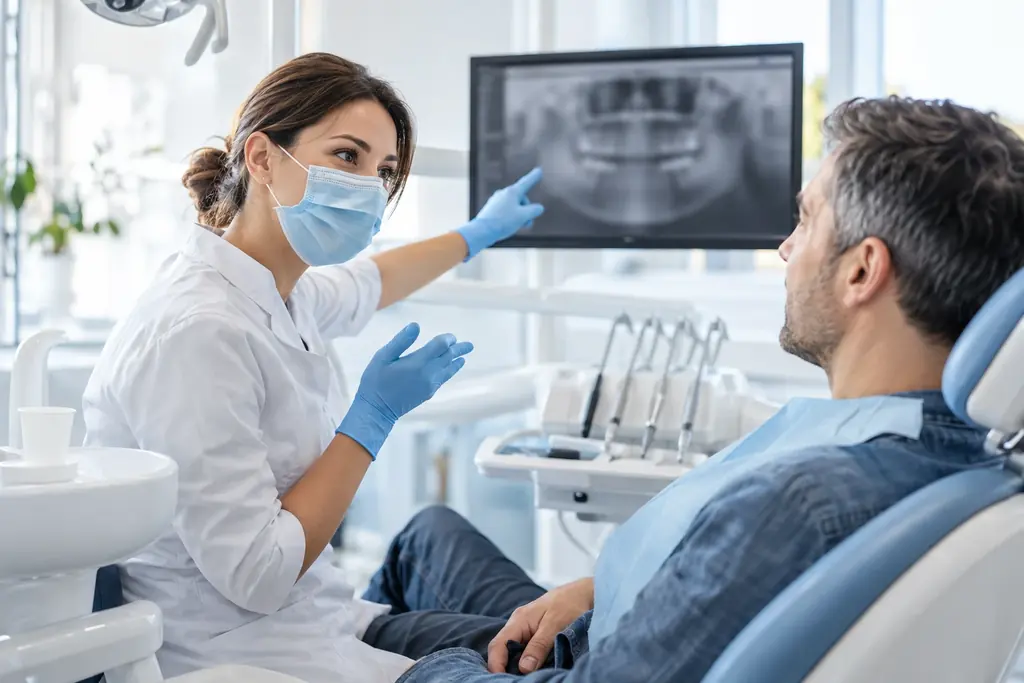
A microscope may be discussed for complex root canal treatment, for retreatment of a tooth treated before (“Root canal retreatment”), when canals are difficult to locate, or when a crack or other small detail needs to be examined. For a straightforward tooth the dentist may not need it.
It is one of the factors to ask about, not a substitute for the other ones: diagnosis, isolation, skill and a good final restoration. See “Root canal treatment” for the basic steps of canal treatment.
Questions about the full treatment protocol
Ask what the whole protocol includes. Typical questions: Will a rubber dam be used? Is the microscope used for the entire procedure or only part of it? Which clinician will treat the tooth, and does that person routinely work with a microscope? How many visits are planned? Which restoration will follow, and is it in the estimate?
Equipment is a means rather than an outcome, so we suggest asking for a written estimate that lists the procedure and the restoration instead of focusing on equipment labels. See “Deep cavity or pulpitis?” if you are still unsure whether the problem is deep decay or an inflamed pulp.
Ask Dentika or Filigranno about an assessment in Lutsk
Request an appointment in LutskCall to check availability: Filigranno (050) 577-48-48 · Dentika (099) 655-00-57
Finding a suitable appointment in Lutsk
To find a suitable appointment in Lutsk, state in your request that you would like microscope treatment and name your preferred clinic: Dentika or Filigranno. The administrator will tell you whether a microscope and a suitable clinician are available, and when.
Prices for related items, such as the rubber dam and canal filling, are listed in UAH: “View prices in UAH”. A summary of services is under “Treatment options in Lutsk”.
Planning dental treatment in Ukraine and comparing costs
Request a quote for the same proposed procedure and equipment protocol in Lutsk and at home. Treatment fees may differ, but compare qualifications, follow-up and total visit costs as well.
Current prices: “View prices in UAH”. The final cost is confirmed after examination.
Travelling to Ukraine: check your government’s current travel advice before planning a trip.
Frequently asked questions
Choose a clinic in Lutsk
Ask Dentika or Filigranno to confirm a suitable clinician and microscope availability for your planned endodontic appointment in Lutsk.

Request an appointment in Lutsk
Choose Dentika or Filigranno and describe the problem — the administrator will confirm availability.
Request received!
The administrator will contact you by phone or message to confirm your appointment.
An online request is not a confirmed appointment until the administrator replies.
Related guides
This guide is general information for patients. It is not a diagnosis and does not replace an in-person examination.