Deep cavity or pulpitis: how a dentist in Lutsk assesses it
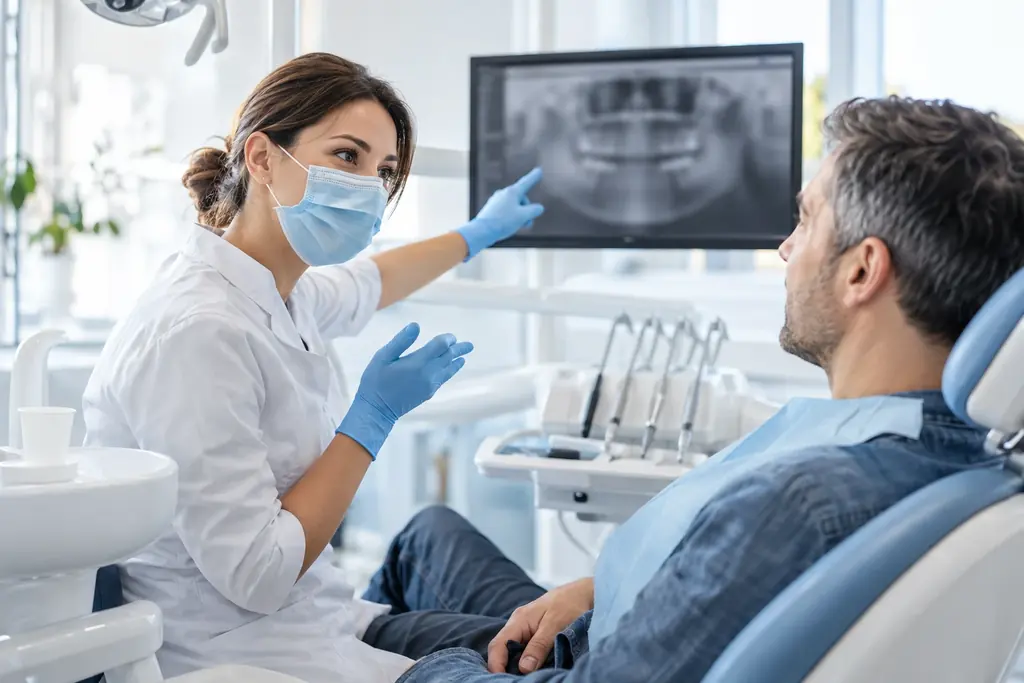
A deep cavity and pulpitis are not the same thing. “Deep” describes how far decay has progressed towards the nerve, while pulpitis means the nerve tissue (the pulp) is inflamed. A deep cavity may have a healthy or an inflamed pulp, and symptoms alone cannot tell which. A dentist in Lutsk examines the tooth, tests how it reacts and uses X-rays where needed to decide between options such as a filling with protection of the pulp, vital pulp therapy or root canal treatment.
When should I see a dentist urgently?
- Strong pain that starts on its own or wakes you at night
- Pain that lingers for a long time after cold or hot drinks
- Swelling of the gum, cheek or face
- Fever with tooth pain
Why symptoms do not establish a diagnosis
Many people ask whether their pain means decay or pulpitis. Sensitivity to cold, lingering pain after hot drinks, pain at night and pain when biting can all occur in both conditions, and they can also be caused by other problems, such as a crack. The same pain can mean different things in different teeth.
For that reason, this guide does not offer a self-test. If you notice these symptoms, a dental examination is the dependable next step; “Why does my tooth hurt?” explains how a dentist approaches tooth pain in general.
What pulp assessment involves
The dentist asks about the history of the pain, then examines the tooth and its surroundings. A cold test and gentle tapping show how the nerve and the tissues around the root respond, and an X-ray shows the depth of the cavity and the area around the root.
It is the combination of findings that matters. For example, brief sensitivity that disappears quickly is interpreted differently from pain that lingers or arises spontaneously.

When different treatments may be discussed
Depending on the findings, the dentist may discuss different approaches: removing decay and placing a filling, protecting a pulp that is judged healthy or likely to recover with a therapeutic liner or other vital pulp therapy, or treating the canals when the pulp is damaged beyond recovery. These are different procedures with different scopes and costs, so do not compare them as substitutes.
Whether the nerve can be preserved depends on the tooth and on what the dentist finds, and no outcome can be promised in advance. For canal treatment, see “Root canal treatment”. A summary of what we arrange is under “Treatment options in Lutsk”.
Ask Dentika or Filigranno about an assessment in Lutsk
Request an appointment in LutskCall to check availability: Filigranno (050) 577-48-48 · Dentika (099) 655-00-57
Planning treatment for deep decay in Lutsk
To arrange an assessment in Lutsk, choose Dentika or Filigranno and describe your symptoms. Ask which clinician will see you and whether the plan can include several options, so you can compare like with like.
If you have existing X-rays, ask how to send them securely. Prices for related services, such as a therapeutic liner, vital pulp therapy and X-rays, are listed in UAH: “View prices in UAH”.
Planning dental treatment in Ukraine and comparing costs
Ask for alternative estimates only for clinically suitable options. Treatment in Lutsk may be financially attractive, but a filling and root canal treatment are different procedures and should not be compared as substitutes.
Current prices: “View prices in UAH”. The final cost is confirmed after examination.
Travelling to Ukraine: check your government’s current travel advice before planning a trip.
Frequently asked questions
Choose a clinic in Lutsk
Request an assessment of deep decay in Lutsk through Dentika or Filigranno; ask about the treatment options and their full costs.

Request an appointment in Lutsk
Choose Dentika or Filigranno and describe the problem — the administrator will confirm availability.
Request received!
The administrator will contact you by phone or message to confirm your appointment.
An online request is not a confirmed appointment until the administrator replies.
Related guides
This guide is general information for patients. It is not a diagnosis and does not replace an in-person examination.